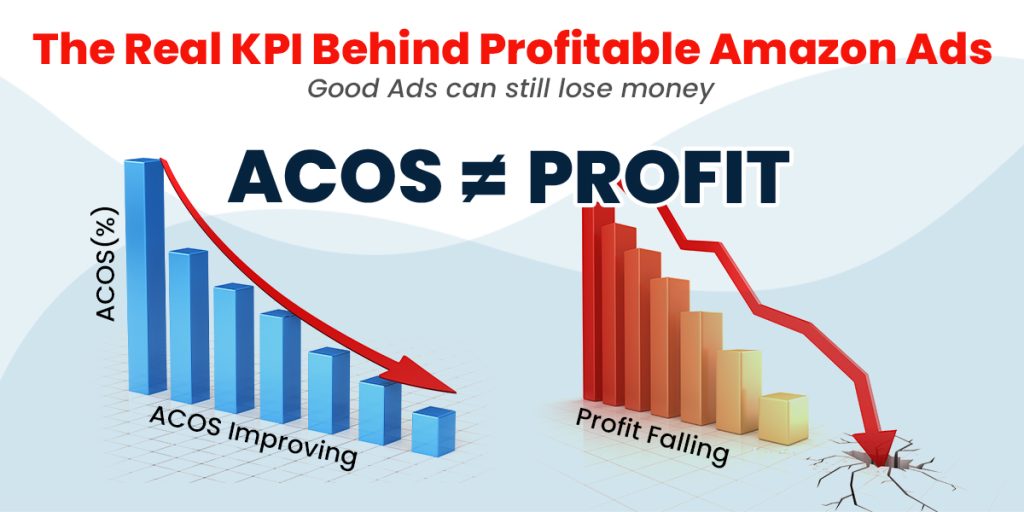
If your Amazon ads show a low ACoS, you probably think you’re winning.
But if cash flow feels tight, growth feels fragile, or scaling makes things worse—not better—your ads may be quietly hurting your business.
This is one of the most common (and dangerous) traps Amazon brands fall into: optimizing ad metrics instead of business outcomes.
Let’s break down the real difference between ACoS, TACoS, and profit, why “good ads” still kill brands on Amazon, and how profitable sellers actually use these metrics.
Why Most Amazon Ads Look “Good” but Feel Bad
At first glance, everything seems fine:
- ACoS is low
- Campaigns are “efficient”
- Revenue is growing
Yet:
- Margins are shrinking
- Inventory feels riskier
- Scaling ads increases stress, not profit
This disconnect happens because ACoS and TACoS are partial truths. They’re not wrong—but they’re incomplete.
What ACoS Actually Measures (And What It Doesn’t)
ACoS Explained in Plain English
ACoS (Advertising Cost of Sale) answers one question:
How much did I spend on ads to generate this specific ad-driven sale?
That’s it.
The Dangerous Blind Spots of ACoS
ACoS completely ignores:
- Organic sales lift
- Product margins
- Fulfillment, storage, and return costs
- Discounts and promotions
- Customer lifetime value
You can have a great ACoS and still:
- Lose money per order
- Train customers to only buy on ads
- Destroy long-term profitability
ACoS is an ad metric, not a business metric.
What TACoS Really Tells You
TACoS Explained for Founders
TACoS (Total Advertising Cost of Sale) measures:
How much ad spend is required to support total revenue—ads + organic.
This makes TACoS far more useful than ACoS because it:
- Shows whether ads are driving organic growth
- Reflects ranking and brand momentum
- Connects ads to overall business efficiency
Why TACoS Is Still Not Enough
Even TACoS doesn’t tell the full story:
- It ignores SKU-level profitability
- It hides cash-flow pressure
- It doesn’t account for fixed costs
A “healthy” TACoS can still coexist with unhealthy profit.
The Metric That Actually Matters: Profit
Why Profit Beats Every Other Metric
Profit answers the only question that matters:
After all costs, does this business generate cash?
This includes:
- Product cost
- Amazon fees
- PPC spend
- Storage, returns, refunds
- Software, labor, and overhead
Revenue is vanity.
ACoS is misleading.
Profit is survival.
How “Good Ads” Destroy Profit
Common ways brands bleed money:
- Over-advertising hero SKUs with thin margins
- Scaling spend without margin protection
- Discounting to “fix” ACoS
- Ignoring storage and long-term FBA fees
- Running ads that steal organic sales
Ads don’t kill brands.
Bad measurement does.
The Most Common ACoS Traps Amazon Brands Fall Into
- Chasing the lowest ACoS instead of the highest contribution margin
- Cutting ads that protect organic rank
- Scaling traffic before fixing conversion rate
- Using blended metrics that hide losing SKUs
- Optimizing campaigns instead of the business
These mistakes feel “smart” in the dashboard—but hurt in real life.
How Profitable Amazon Brands Actually Use These Metrics
The Correct Hierarchy of Metrics
Successful brands prioritize metrics in this order:
- Profit
- Contribution margin
- TACoS
- ACoS
ACoS is last—not first.
When High ACoS Is Actually a Good Thing
High ACoS can be strategic when:
- Launching new products
- Defending top keywords
- Dominating branded search
- Accelerating organic rank
The key is intentional loss, not accidental loss.
A Simple Framework to Fix Ads That Look “Good”
Step 1: Calculate Real Contribution Margin
Know exactly how much profit remains before ads.
Step 2: Set Profit-Based ACoS Targets
Your break-even ACoS should be math-based—not emotional.
Step 3: Separate Growth Ads from Harvest Ads
- Growth ads: ranking and visibility
- Harvest ads: profitable demand capture
Never mix the two.
Step 4: Fix Conversion Before Scaling Spend
Traffic amplifies problems. Conversion fixes them.
Step 5: Track Profit Weekly
Not monthly. Not “eventually.” Weekly.
ACoS vs TACoS vs Profit — Quick Comparison
Metric What It Measures Useful For Dangerous When ACoS Ad efficiency Campaign tuning Used as success metric TACoS Business efficiency Growth tracking Ignoring margins Profit Cash generation Decision-making Never dangerous
Frequently Asked Questions
Is low ACoS always good on Amazon?
No. Low ACoS can hide poor margins, weak organic growth, and long-term losses.
What is a healthy TACoS for Amazon brands?
It depends on margins and lifecycle stage, not arbitrary benchmarks.
Can you be profitable with high ACoS?
Yes—if the product has strong margins or ads drive organic rank.
Which metric should Amazon sellers focus on most?
Profit. Always profit.
Conclusion: Stop Optimizing Ads—Start Optimizing the Business
Most Amazon brands don’t fail because their ads are bad.
They fail because they optimize the wrong metrics.
ACoS and TACoS are tools—not goals.
Profit is the goal.
If your ads look great but your business feels fragile, the fix isn’t better campaigns.
It’s better measurement, better structure, and better decisions.